Panel Greenhouse Trailers for Mobile STEM Labs Built Tough
By Takumi Sato • 28th Aug
What to do first
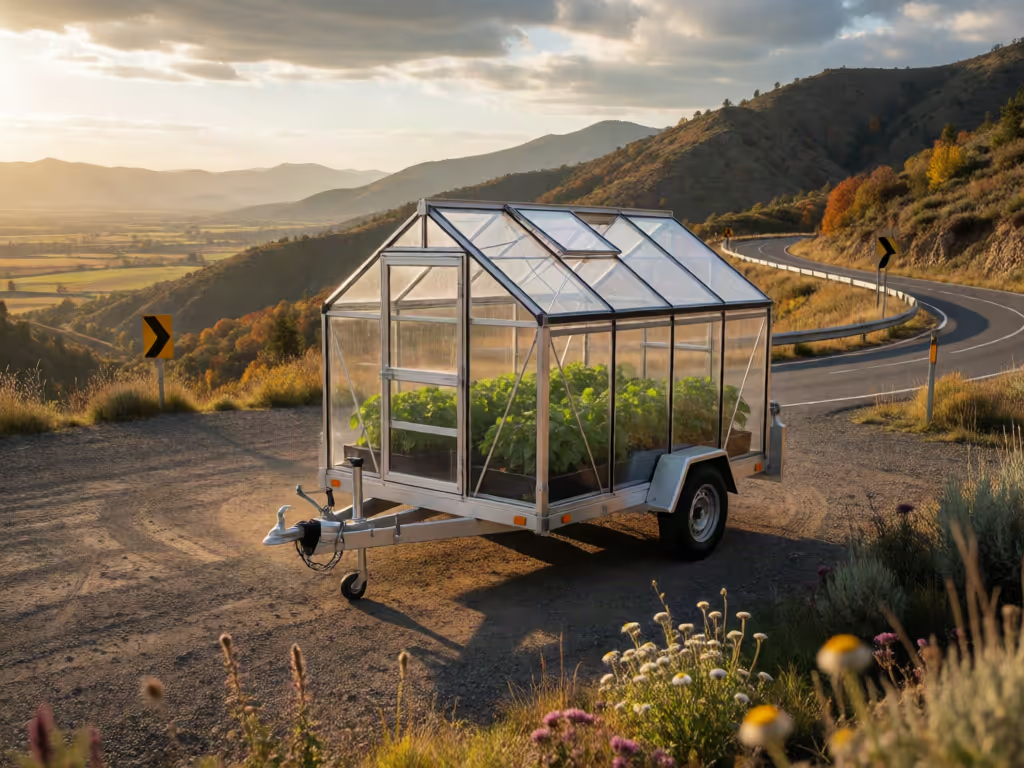
A mobile panel greenhouse can bring plant science to schools, but the available evidence does not establish a ready-to-buy, roadworthy STEM-lab trailer.
- First action: Issue a focused request for information covering transport configuration, deployment anchoring, ventilation and humidity control, monitoring, maintenance, and site-specific engineering or code review.
- Likely explanation: The identified examples are not interchangeable commercial products: the Clegg page provides only a named specialized application, Evie was a reported student-built prototype, and Ceres is documented as a custom greenhouse provider—not as a verified mobile trailer seller.
Important: General greenhouse guidance supports managing heat, humidity, airflow, and supplemental heat when solar radiation is limited, but no collected source supplies product-level specifications, prices, towing data, accessibility compliance, containment certification, or educational outcome evidence.
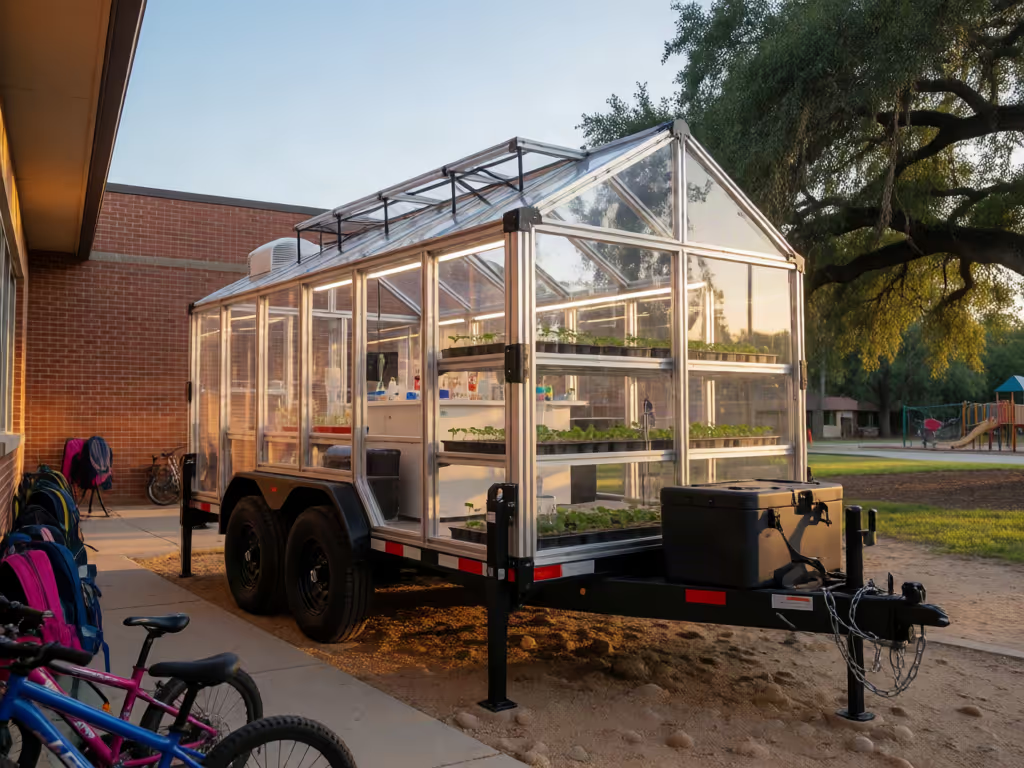
A panel greenhouse on wheels can be a powerful teaching tool, but a traveling greenhouse lab is not automatically a safe, durable, or procurement-ready educational greenhouse trailer. The hard part is not growing seedlings in a bright enclosure. It is keeping plants alive through heat, humidity, loading, travel, setup, and weather while protecting students, staff, and the public. If the proposal cannot answer how the unit is secured on site, managed between visits, and verified for the roads it will travel, it is a concept, not yet a mobile STEM greenhouse kit worth buying.
That distinction matters. A mobile greenhouse trailer raises two separate questions: how it will travel and how it will be stabilized at a site. I have seen what happens when the second job gets treated as an accessory: after a coastal storm, the field was full of twisted frames whose anchors had been more symbolic than structural. Mobility does not excuse a weak tie-down plan. Wind is a test you schedule for.
The Problem: "Mobile" Is Often Used Before the Hard Questions Are Answered
Schools, nonprofits, extension programs, and community gardens want a school outreach greenhouse because it brings living systems to places without permanent gardens. That is a real use case. One reported Bozeman program used a mobile greenhouse to teach elementary students at schools that could not afford gardens about photosynthesis, gardening, and healthy eating, with lessons connected to the district science curriculum. The access value is obvious.
But the market language gets ahead of the engineering language. "Panel," "passive solar," "lab," and "trailer" sound like a finished specification. They are not. None tells you:
- whether the frame and enclosure have a documented design basis for the weather at each deployment site;
- how the unit is stabilized, leveled, and anchored after it leaves the road;
- what happens to ventilation and moisture when the unit is locked between visits;
- whether the trailer's transport configuration, lighting, permits, and operating classification have been reviewed for its actual routes;
- how educators will supervise a living system that still needs care when no class is inside.
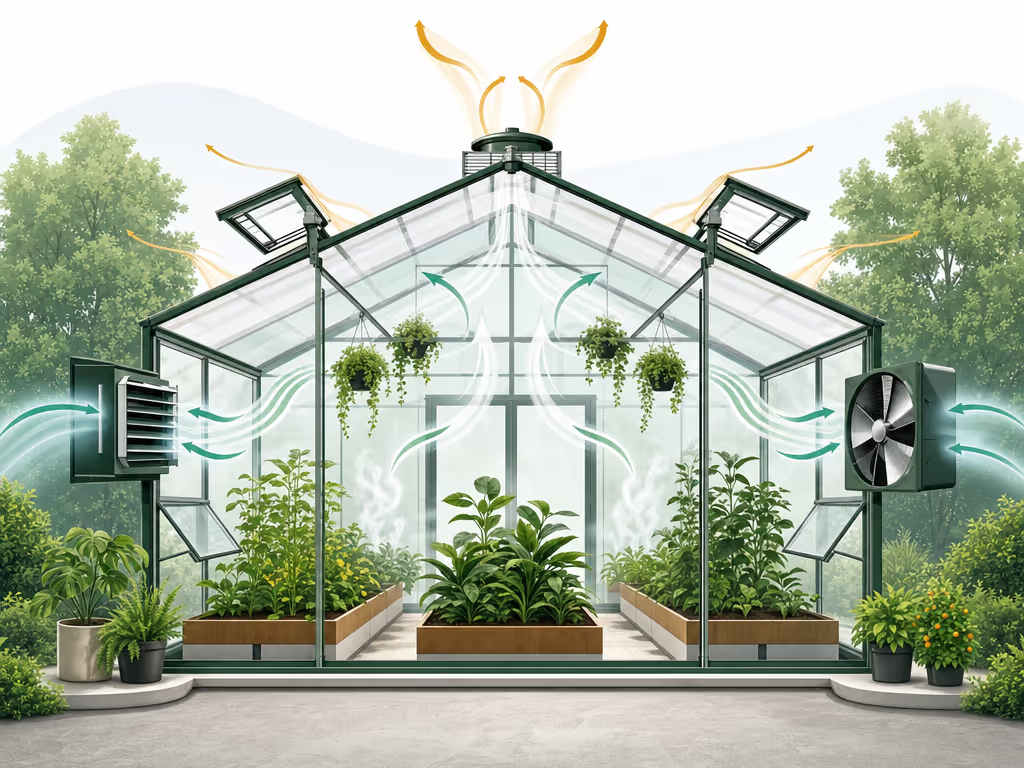
A greenhouse is a managed plant environment, not merely a transparent classroom. Temperature, light, and humidity must be managed alongside watering, fertilization, and routine crop care. Greenhouse ventilation systems have two non-negotiable plant-health jobs: they remove excess heat and help control relative humidity and carbon dioxide around the canopy.
If a vendor can show the classroom story but cannot document the failure controls, keep the purchase order closed.
Agitate: The Failure Modes Are Predictable, and Expensive
The dangerous version of a traveling greenhouse lab is not always a dramatic blow-over. More often, it is a chain of ordinary omissions.
Failure mode 1: The greenhouse becomes a heat box
Sunlight enters. Air temperature climbs. Plants wilt, students are uncomfortable, and the lesson turns into an evacuation. Ventilation is not decorative; its purpose is to replace hot interior air with cooler outdoor air. A closed trailer also requires a clear plan for missed visits, failed controls, and staff handoffs.
Do not accept "natural ventilation" or "air conditioned" as an answer by itself. Ask the supplier to state the complete operating sequence: what initiates ventilation, who verifies it, and what happens if the unit is unattended.
Failure mode 2: Humidity management gets ignored
Greenhouse airflow helps control relative humidity and carbon dioxide around the plant canopy. That is why humidity control and canopy airflow belong in the operational plan from day one. A beautiful glazed box without a credible humidity-management routine leaves a critical operating question unanswered.
Failure mode 3: Road configuration is confused with site configuration
A trailer that can be moved is not necessarily ready for public-road operation in your program. Federal commercial-vehicle lighting guidance states that stop lamps must activate when brakes are applied and that lamps and reflectors must be visible, with exceptions. Certain trailers manufactured on or after December 1, 1993 are described in that guidance as requiring retroreflective sheeting or additional reflex reflectors.
That does not settle the rules for a particular school-owned, nonprofit, intrastate, or commercial operation. Applicability depends on use, jurisdiction, and classification. Treat it as a reason to have the relevant transport and permitting authorities review the planned operation, not as a box to check from a web page.
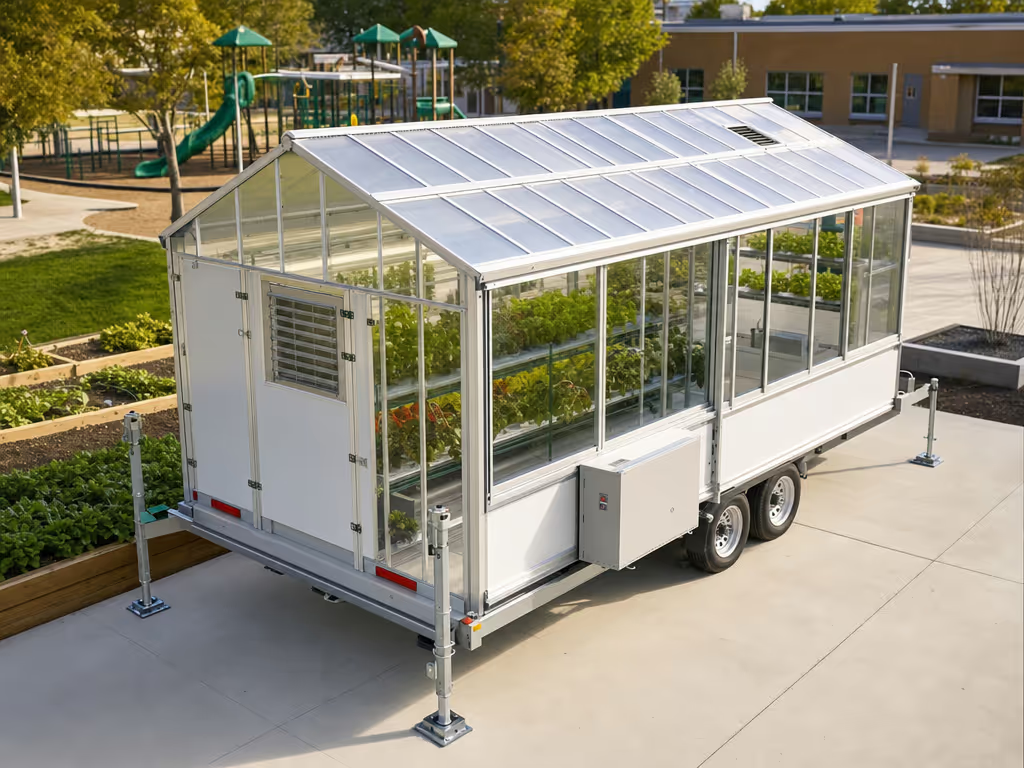
Failure mode 4: The unit arrives, but cannot safely stay put
A school district's portable-classroom relocation procurement provides a useful warning, not a transferable greenhouse specification. Its process included leveling, blocking, anchoring, and inspection of anchor tie-downs and footers; it also required transportation permits for relocations. The lesson is plain: arrival is not installation.
A mobile greenhouse needs an engineered, site-specific anchoring plan appropriate to its trailer, deployment duration, soil or paving condition, exposure, and governing code. Do not substitute light anchors, improvised ballast, or an unverified "temporary" solution. I will not endorse undersized anchors because they tend to work perfectly, until the one gust that matters.
Failure mode 5: "Containment" gets mistaken for certification
The phrase sounds authoritative, which makes it risky. A Clegg Industries page names a USDA/APHIS Mobile Greenhouse Containment Laboratory Trailer - Wall Mount AC Application. The available material identifies that named application and places it in the company's wall-mount heating and air-conditioning navigation.
What it does not provide is the information a school or research buyer would need to claim a containment level, biosafety protocol, laboratory certification, HVAC capacity, or regulatory approval. Never infer any of those from the title. If your program truly needs laboratory containment, the required approvals and performance criteria must be defined by the responsible authorities and verified in the project documentation.
Solve: Compare the Concepts Honestly Before You Commission a Unit
There are only two identified mobile-greenhouse reference projects worth discussing from the available information, and they are not interchangeable commercial products. Ceres is not a verified trailer offering.
1. Clegg Industries USDA/APHIS Mobile Greenhouse Containment Laboratory Trailer: a named specialized application, not a buyer-ready spec
What is established: Clegg Industries has a page titled USDA/APHIS Mobile Greenhouse Containment Laboratory Trailer - Wall Mount AC Application. That confirms the named application exists in the company's published material.
What is not established: trailer dimensions, towing requirements, axle configuration, brakes, electrical system, glazing, structural performance, environmental-control capacity, laboratory equipment, containment level, or approvals.
Best procurement interpretation: This is a lead to investigate if your institution has a specialized greenhouse or research-trailer requirement. It is not enough evidence to score the unit for weather resilience, student usability, route suitability, or total cost.
Procurement gate: Require a written submittal package that separates three scopes:
- Transport scope - exactly how and where it may travel.
- Deployed-site scope - leveling, anchoring, weather limits, and inspection responsibility.
- Plant/lab scope - climate control, maintenance procedures, and any applicable regulatory requirements.
If the vendor cannot keep those scopes distinct, the project has a coordination problem before it has a greenhouse problem.
2. Evie from SMU's Hunt Institute: a valuable education prototype, not a commercial kit
SMU reported in 2017 that Hunt Institute students transformed an old Shasta camping trailer into "Evie," a fully functioning experimental mobile greenhouse. The redesign was intended to grow food and support research into food deserts, with the mobility concept supporting food distribution and education.
That is compelling program design. It demonstrates why a traveling greenhouse lab can move the lesson to the learners rather than wait for every school to build a garden.
The limitation is equally important: Evie was a student-led, experimental project and a nickname, not a documented commercial model. Available information does not establish current availability, purchase terms, weather rating, roadworthiness details, lesson plans, student capacity, accessibility, or operating costs.
Best procurement interpretation: Use Evie as inspiration for the mission: food access, visible plant science, and place-based learning. Do not use it as a structural or purchasing benchmark. A conversion can be excellent, but any replication needs professional review of the trailer and structure as built, not confidence borrowed from a photo.
3. Ceres Greenhouse Solutions: a potential custom-design conversation, not a verified mobile trailer
Ceres Greenhouse Solutions says it serves commercial growers, educators, research institutions, and homeowners. The company also says its design process includes design and energy modeling, and that its turnkey scope can include MEP engineering, architectural support, and construction oversight.
Those statements make Ceres relevant if you need a custom greenhouse partner for an education project. But the available information does not identify a product or project called a Mobile Passive Solar Educational Greenhouse Trailer. Do not list it as a purchasable trailer, and do not assume passive-solar design makes a unit self-sufficient in cloudy or cold conditions. General greenhouse guidance notes that solar greenhouses may need supplemental heat when cloud cover limits solar radiation.
Best procurement interpretation: Ask whether the company will consider a trailer-mounted education unit, and obtain project-specific scope, engineering, operations, and site-deployment requirements in writing. That is a commissioning conversation, not a product comparison.
The Four-Season Commissioning Score
Because verified model-level data are missing for these examples, a numeric ranking would be false precision. Use this pass/fail scorecard with every supplier instead. Award a category only when the answer is written, project-specific, and reviewable.
1. Structural and site resilience
Pass only when the supplier provides:
- the stated weather-design assumptions and the engineer responsible for them;
- a deployment-site stabilization, leveling, and anchoring plan;
- defined conditions when the unit must not be deployed or occupied;
- connection details and an inspection process after setup and before public use.
Red flag: "It is heavy enough" or "we have never had an issue." Neither is a design basis.
2. Environmental control and crop survivability
Pass only when the supplier provides:
- the ventilation approach for heat removal;
- the approach to humidity control and canopy airflow;
- monitoring, alarms, and staff responsibility when the trailer is unattended;
- a plan for cloudy-weather heat limitations when the operating season requires it.
Red flag: A design that treats plants as display props rather than living organisms with daily needs.
3. Transport and public-facing readiness
Pass only when the program has confirmed:
- the applicable transport, lighting, reflector, registration, and permit requirements with the relevant authorities;
- the approved routes, movement responsibility, and pre-departure inspection procedure;
- the distinction between road configuration and parked, deployed configuration.
Red flag: A supplier answer that cites a general rule but will not address your actual operation and jurisdiction.
4. Educational operations
Pass only when the program defines:
- the lesson purpose and the plants that make that purpose visible;
- who opens, closes, waters, monitors, and cleans the unit;
- how curriculum is connected to the visit;
- what happens to the crops between schools and during breaks.
The Bozeman example shows one workable direction: mobile lessons tied to science curriculum can bring photosynthesis, gardening, and healthy-eating instruction to schools that could not afford gardens. It should inform your program design, not replace it.
A project that passes all four categories has something more useful than a marketing label: a defensible operating concept.
A Hard-Nosed Pre-Purchase Checklist
Before approving a panel greenhouse trailer, send this list to every candidate supplier or custom builder:
- Provide the complete trailer and greenhouse drawings, including how the structure is supported during travel and after deployment.
- Identify the engineer and code pathway for the planned use and sites. Confirm the applicable building, fire, electrical, zoning, school-facility, and transport requirements with the relevant authorities.
- Provide the anchoring and stabilization plan for each deployment condition. Require the responsible party to specify inspection and signoff.
- Document the environmental-control sequence for heat, humidity, light, watering, and cold or cloudy periods.
- Define the operating limits. Ask when the trailer must remain closed, moved, serviced, or removed from a site.
- Confirm transport compliance with the authorities that govern your routes. Do this before branding, scheduling, or grant announcements.
- Run a full setup drill. Time the process, assign roles, verify all hardware, and record every step that requires tools or special training.
- Write the weekly plant-care plan. Name the caretakers and assign recurring inspections and care tasks before the trailer begins traveling between sites. Use a seasonal greenhouse maintenance checklist to assign recurring inspections and care tasks before the trailer begins traveling between sites.
Make the Next Decision Small and Verifiable
The right next step is not to choose the prettiest educational greenhouse trailer. It is to issue a one-page request for information using the Four-Season Commissioning Score, then reject any response that does not supply a clear structural, environmental, transport, and operations answer.
Start with your intended sites and mission. Then make the vendor prove the unit can live there safely. That is how a mobile STEM greenhouse kit becomes an asset rather than a recurring emergency. Overbuild once; sleep through the wind warnings at night.
Related Articles