
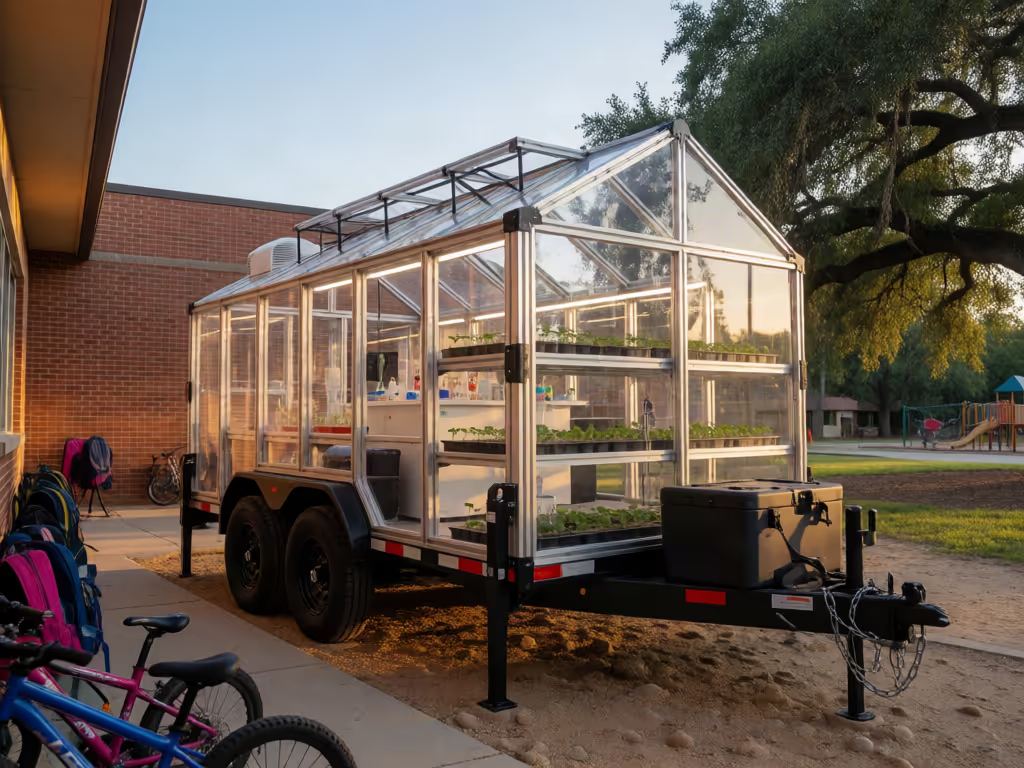
Mobile Greenhouse Trailer FAQ: Roadworthy All Season Growing
By Maya Okonkwo • 7th Aug
Quick answer
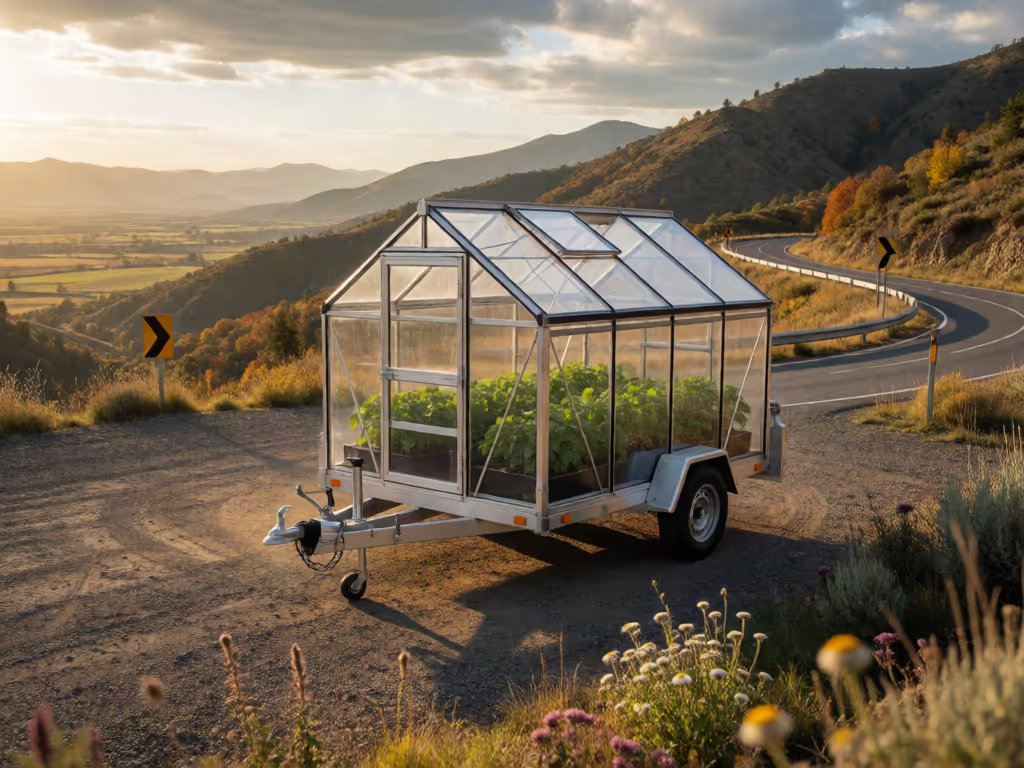
A mobile greenhouse trailer can be built, but “mobile,” “roadworthy,” and “all-season” describe different claims. Custom truck and specialty trailer examples prove feasibility—not universal legality, towing capability, or year-round growing performance.
- Short answer: A patio greenhouse on castors is for gentle repositioning, while custom greenhouse trucks and specialty trailers are substantially different categories.
- Key distinction: Before treating a unit as roadworthy, request configuration-specific vehicle and compliance documentation; FMCSA cargo rules alone are not a complete legal standard.
- Important caveat: No available evidence establishes universal freeze protection, climate performance, or all-season suitability. Verify structural, thermal, transport, and local permitting requirements for the exact build.
A mobile greenhouse trailer can mean anything from a small mobile greenhouse on wheels that rolls across a sheltered patio to a purpose-built, highway-scale specialty vehicle. That gap matters. Wheels are not evidence of roadworthiness, and a glass roof is not evidence of all-season performance. Before comparing layouts or a custom greenhouse kit, separate what is documented from what is merely implied. Numbers first, claims second (your climate decides the kit).
Load ratings aren't opinions.
First: What Does "Mobile" Actually Mean?
Is a mobile greenhouse on wheels automatically towable?
No. Castors and highway mobility are different product categories. A manufacturer of a wheeled garden greenhouse describes its wheeled kit as suitable for gently moving the unit around a sheltered patio or balcony. That is useful local repositioning, not a claim of road legality or towing capability.
At the other end of the spectrum, documented custom builds do exist. One builder describes a USDA/APHIS mobile greenhouse containment-laboratory trailer as an all-aluminum, triple-axle gooseneck measuring 49 ft long × 102 in. wide × 10 ft high, designed for citrus-industry field research. Concession Nation also describes custom mobile-greenhouse truck projects, including 16-foot examples.
The practical conclusion is simple: do not use "mobile" as a specification. Ask which kind of movement the seller means.
| Term used in a listing | What the available documentation can support | What it does not prove |
|---|---|---|
| Mobile greenhouse on wheels | Gentle movement around a sheltered patio or balcony for one wheeled garden model | Highway towing, registration, or road legality |
| Mobile greenhouse truck | Custom truck-based greenhouse projects have been described by a manufacturer | Standard equipment, ratings, or independent certification |
| Trailer-based greenhouse | A purpose-built specialty gooseneck greenhouse trailer has been documented | That every trailer greenhouse is roadworthy or all-season capable |
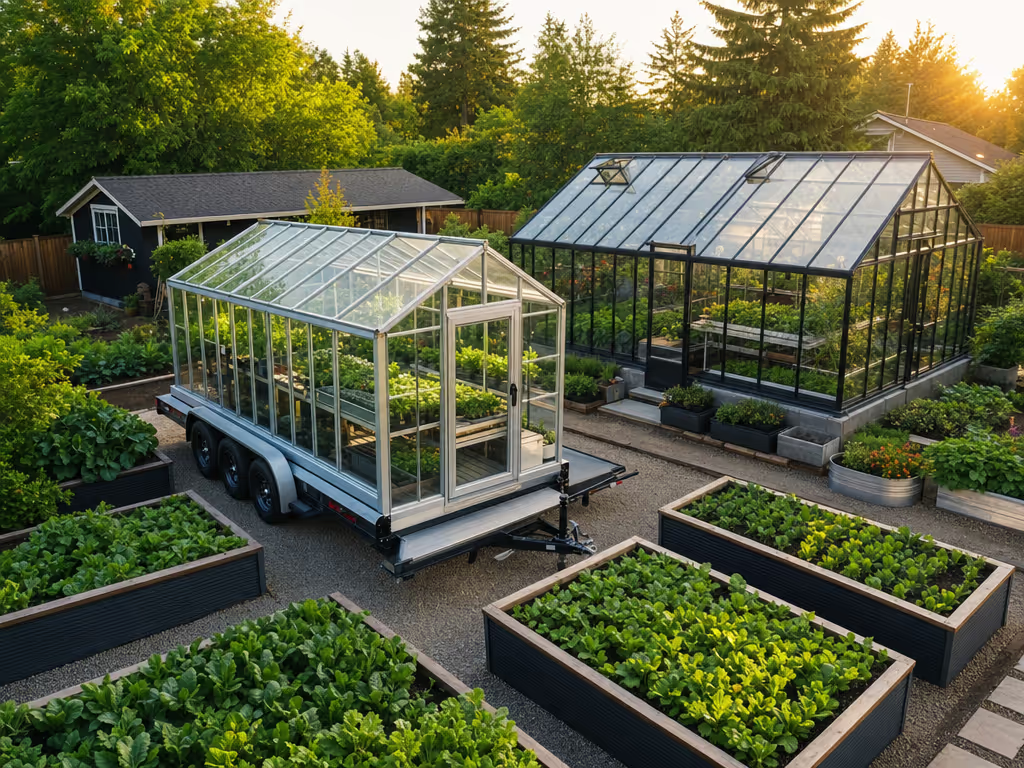
Can you put a greenhouse on a trailer?
Yes - custom projects show that it can be done. The clearest documented example is the USDA/APHIS containment-laboratory trailer above. Concession Nation also reports mobile-greenhouse truck builds for Boston Cityscapes in 2019, Bayside Garden Center in 2021, and Warren County High School in 2024.
But those examples establish existence, not a ready-made blueprint for a homeowner or school. The laboratory trailer was a specialized field-research project. Its builder-reported power arrangement (shore power with automatic cable retraction backed by a 25 kW generator set) and its listed HVAC equipment are project details, not a universal recommendation and not evidence that its systems operate while driving.
Treat a trailer-based portable greenhouse kit as a custom-build category unless the supplier gives you model-specific documents. A photo, a wheel count, or a marketing label cannot fill that gap.
Roadworthy: What Can You Verify?
Do FMCSA cargo rules make a greenhouse trailer road legal?
No. They are not a complete roadworthiness standard for greenhouse trailers. FMCSA cargo-securement rules apply to cargo-carrying commercial motor vehicles operated in interstate commerce. Their scope does not automatically cover private trailers, local operation, or a greenhouse installation.
Within that commercial scope, FMCSA says cargo must be firmly immobilized or secured by adequate-strength structures, tiedowns, or a combination. The rules specify separate force thresholds of:
- 0.8 g forward deceleration
- 0.5 g rearward acceleration
- 0.5 g lateral acceleration
They also set a minimum aggregate working-load limit of at least one-half of the restrained article or group’s weight, subject to the applicable tiedown arrangement.
Those numbers are valuable because they show why "it looks firmly attached" is not a standard. They do not tell you whether a particular greenhouse trailer meets vehicle, towing, lighting, brake, tire, dimensional, inspection, registration, licensing, or provincial/state requirements.
What should I request before calling a unit roadworthy?
Request documents, not assurances. There is no universal roadworthy specification for this category, so a buyer should pause until the builder or relevant local authority can address the specific unit and intended operation.
Ask for clear written answers to these questions:
- Is the unit intended only for on-site repositioning, or for towing on public roads?
- What are the exact completed dimensions and configuration of this build?
- Which transport-related components and compliance documents accompany it?
- What items inside the greenhouse are designed to remain secured during transport?
- Which authority should confirm registration, permits, and local operating rules for the intended location and use?
Do not substitute a generic greenhouse manual for vehicle documentation. Likewise, do not assume a trailer builder's work is a climate-performance report.
All-Season: What Does the Evidence Actually Show?
Does a mobile greenhouse trailer guarantee year-round growing?
No universal all-season claim is supported by the documented examples. The specialty USDA/APHIS trailer is described as having two 5-ton Bard HVAC wall units and one rooftop unit, but it was a containment-laboratory project. The project description does not establish performance while in motion, a heating or cooling calculation, an R-value, freeze protection, humidity control, or a result for a home greenhouse garden.
Similarly, Concession Nation lists custom flooring, LED lighting, a glass roof, outside lighting, and a custom wrap for named 16-foot truck builds. Those are manufacturer-described features of individual builds, not a standard specification for every build and not a documented thermal rating.
A disciplined question is not "Does it have HVAC?" It is: What performance documentation is provided for this exact enclosure, its intended parked location, and its operating plan? If the seller cannot provide that information, the all-season label remains unproven.
Will an unheated mobile greenhouse keep plants from freezing?
This cannot be answered from the available information. No reliable horticultural or climate-control source establishes freeze protection for unheated mobile or portable greenhouses. Avoid making a purchase decision on an unverified promise that an enclosure will prevent freezing.
What about wind, snow, and anchoring?
For a buyer concerned about storms, the responsible answer is to insist on published, project-specific structural information rather than assuming mobility answers the question. I favor verified wind and snow ratings, cross-bracing details, anchoring instructions where applicable, and published thermal performance over aesthetics. If those documents are absent, I will not speculate. For site-specific anchoring guidance, review these greenhouse foundation solutions for different soil conditions.
That is not caution for its own sake. It is a clear decision rule: an attractive structure without load documentation cannot be benchmarked against the conditions you expect it to face.
Cost and Permission Questions Buyers Often Ask
Are portable greenhouses worth it?
The available information cannot calculate that for you. It distinguishes patio repositioning from custom truck and trailer projects, but provides no comparative pricing, yield, durability, energy-cost, or return-on-investment data. "Worth it" depends on a budget case the seller should be able to document for the exact configuration you are considering.
Do not compare a castor-mounted garden unit with a specialized trailer laboratory as if they are interchangeable options. They solve different mobility problems.
Do you need a permit for a portable greenhouse?
Check locally before purchase or installation. Permit requirements are jurisdiction- and installation-specific, and there is no universal answer. The same applies to vehicle-law questions: obtain the applicable guidance from your local authority rather than relying on an online listing.
A Better Buying Decision
A mobile greenhouse trailer is not one thing. It is a label applied to at least three materially different ideas: a patio greenhouse that can be rolled a short distance, a custom greenhouse truck, and a purpose-built specialty trailer.
For a serious greenhouse garden project, narrow the decision in this order:
- Define movement: sheltered-patio repositioning, on-site relocation, or public-road transport.
- Match the evidence to that movement: castor guidance is not towing documentation; a project gallery is not a model rating.
- Demand measurable performance records: published wind/snow ratings, enclosure thermal documentation, and configuration-specific operating details where those claims are being made.
- Confirm local rules independently: especially before budgeting for a trailer, site work, or installation.
The phrase "roadworthy all season growing" combines two promises that require separate proof. Keep them separate, ask for the documents behind each, and continue exploring only the designs that can meet that standard in writing.
Related Articles