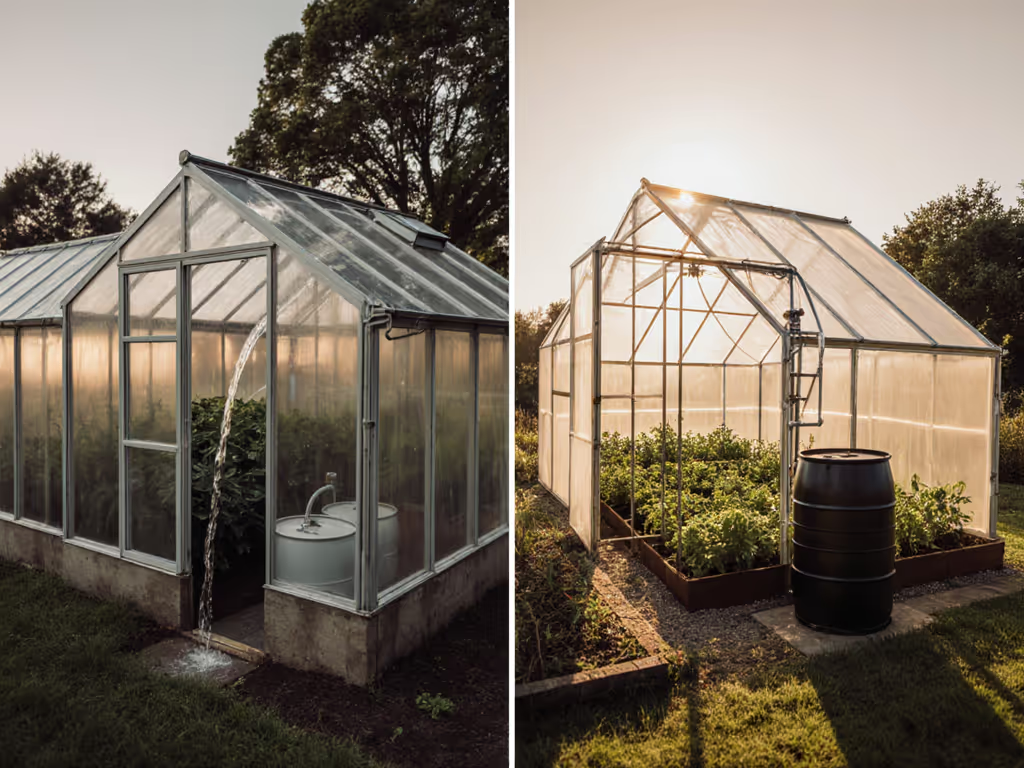
Rainwater Harvesting: Integrated vs. Add-On Greenhouse
By Takumi Sato • 20th Apr
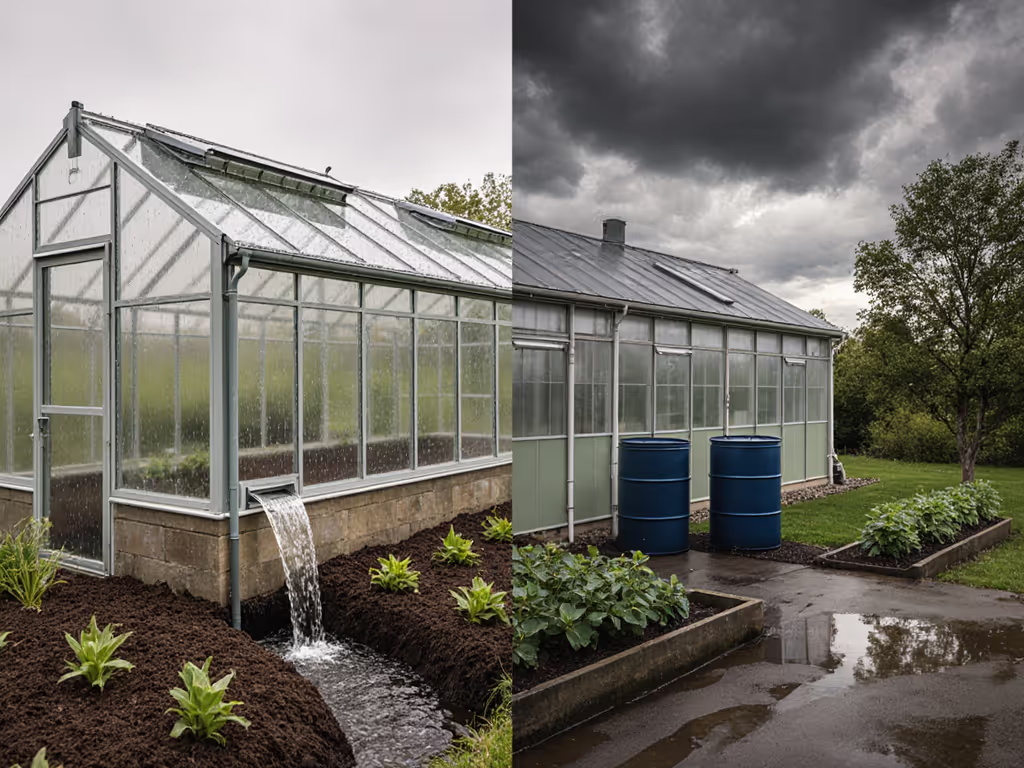
The promise of rainwater-harvesting greenhouse comparison systems (closed-loop water independence) sounds elegant until you're staring at a $12,000 cistern that will not fit your footprint, or a jury-rigged add-on that strains your structure every storm. Most growers treat water capture as an afterthought, bolted onto frames designed without it in mind. That's where failures hide. For options and capacity benchmarks, see our rainwater-harvesting greenhouses guide. The choice between integrated water collection systems and add-on approaches is not academic; it is about whether your greenhouse stands reliably for 15 years, or becomes a liability waiting to fail.
I've seen greenhouses collapse under snow load because someone mounted a 5,000-gallon tank on a roof engineered for its own weight plus passive wind loading. I've watched systems leak, corrode, and fracture because they were retrofit without proper drainage, bracing, or code review. The best systems are designed from the foundation up, with water management as a structural reality, not a retrofit luxury. This guide cuts through the marketing and shows you where the real tradeoffs live.
Why Integrated and Add-On Systems Aren't Equivalent
What Is an Integrated System?
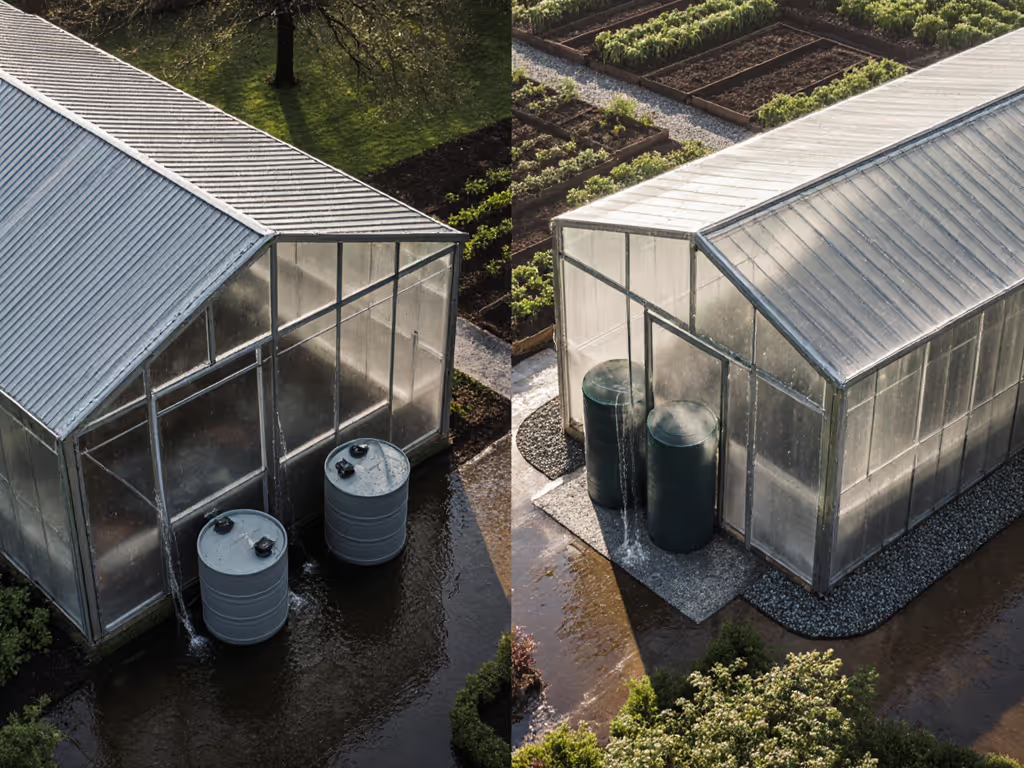
An integrated rainwater system is engineered into the greenhouse from day one. Gutters are designed and sized for your roof pitch and projected runoff volume[4]. Downspouts route into a cistern or tank sited adjacent to or beneath the structure, ideally with gravity-fed delivery into the greenhouse. Load calculations account for stored water, both in the tank footprint and in the structural anchoring that must resist the lateral and vertical forces that water weight creates during filling, temperature cycling, and freeze conditions. If your site has challenging clay or sandy soils, start with our soil-specific greenhouse foundation guide.
Builders who design greenhouses this way start with the worst-case scenario: frozen water expanding in winter, soil settling beneath a buried tank, wind shear on a full cistern during a squall. They oversize gutters, anchor tanks with helical or post-tension foundations, and install overflow management. Strong enough is not enough; they design for failure to not happen.
What Is an Add-On System?
Add-on systems are bolt-on aftermarket solutions. You purchase a freestanding tank (often 500 to 2,000 gallons) and position it outside the greenhouse, then run collection lines from the roof into it. Simpler on paper. Cheaper upfront. Far riskier in practice.
Add-on tanks are typically rated for static water load only; they assume level, undisturbed ground and no lateral wind pressure. When you site one in a wind corridor or on uneven terrain, or when winter frost heaves the soil 3 inches, that tank can twist, develop leaks at seams, or topple. And because they're external, collection piping must cross outdoor exposed runs, which are vulnerable to freeze-thaw cycles, UV degradation, and disconnection during storms.
The Structural Reality: Load Is Not Optional
Here's the detail that separates decision from regret: water weighs 8.3 pounds per gallon[6]. A 1,000-gallon cistern weighs 8,300 pounds. A 5,000-gallon tank weighs over 41,000 pounds, roughly equivalent to a parked semi-truck.
If that water is integrated into the greenhouse design, the foundation, anchor posts, and soil preparation account for it. The greenhouse frame is stress-tested. Gutters and downspout diameter are calculated[4] using the roof area and your annual rainfall, not guessed. For a typical 200-square-foot lean-to, 1 inch of rainfall yields 125 gallons; if you live in a region with 50 inches of annual rain and 30-inch snow loads, you're looking at 6,250 gallons of collected water plus snow weight plus wind load, all competing for the same real estate. Compare cold climate greenhouse kits with verified snow load ratings.
If the tank is added later (bolted outside without foundation design), you're relying on the original anchor system (designed for a lighter, empty structure) to hold a new load it was never intended to carry. I walked a field after a coastal storm where seventeen bolted-on tanks had twisted their mounting brackets and snapped guy-wires. The greenhouses they served stayed put; the hastily installed water systems did not.
Cost: Upfront vs. Total Ownership
Integrated Systems
Upfront cost: $4,000-$8,000 more than a base greenhouse, depending on tank size and foundation depth.
Why the premium?
- Site assessment and foundation engineering
- Tank siting, buried piping (if underground[4]), overflow management
- Oversize gutters and downspouts to handle peak runoff
- Proper grading and drainage design
- Permits and code compliance documentation
Long-term cost reductions:
- No tank replacement (buried concrete or reinforced plastic tanks[6] last 30+ years)
- No freeze-thaw piping failures, because underground lines are insulated and below frost line
- Minimal maintenance, with annual screen cleaning and no corrosion of external mounting hardware
- ROI recovery in 4-6 years for climates with 40+ inches rainfall[2]
- Insurance and liability clarity; code compliance means lower premiums
Add-On Systems
Upfront cost: $800-$2,500, depending on tank capacity and collection kit.
Why the bargain?
- Off-the-shelf tank and fittings
- Minimal site work
- No structural engineering fee
Hidden long-term costs:
- Tank replacement every 8-10 years due to UV degradation and seam fatigue
- Piping freeze damage in winter; replacement of outdoor collection lines annually or biennially
- Potential frame reinforcement if tank anchoring fails and load transfers unexpectedly to greenhouse posts
- Productivity loss, with downtime for repairs during growing season
- Warranty disputes: add-on tanks often void greenhouse warranty if attached with bolts or straps
- Permit liability: unpermitted cisterns or improper grading can trigger code enforcement and removal orders
True 15-year cost: $3,500-$6,500 (tank replacements, piping repairs, potential structure reinforcement). To avoid coverage issues, read our greenhouse warranty guide.
Water Capture Efficiency: Dry vs. Wet Logic
Your greenhouse gutter system design determines how much rainwater you actually harvest.
Integrated dry-system approach:[4] Gutters route directly into tank inlet; piping empties fully after rain. Pros: simple, less maintenance, ideal for climates with infrequent large storms. Cons: can't collect from multiple downspouts efficiently; the tank must be sized to catch the whole event or overflow is wasted.
Integrated wet-system approach:[4] Underground collection piping connects multiple gutters, allowing water to rise into a tank positioned away from the structure. Pros: captures from the entire roof surface; tank placement flexibility. Cons: higher upfront cost; requires sufficient elevation drop from gutters to tank inlet; underground piping adds complexity.
Add-on systems typically default to dry logic (one downspout, one tank), which means you capture only 40-60% of available runoff because secondary gutters or storm intensity exceed tank capacity and overflow.
Climate-Specific Water Harvesting Trade-Offs
Cold Climates (Snowbelt, Northern Plains)
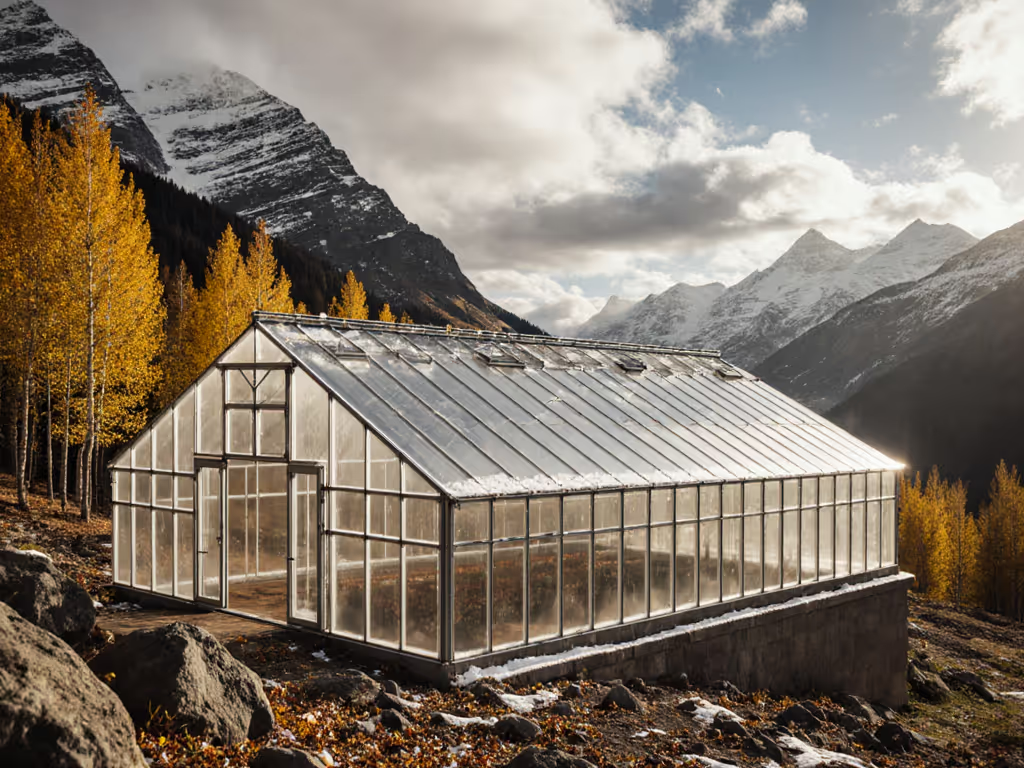
Integrated advantage: Tank can be buried below frost line (typically 3-4 feet), protecting water from freezing and piping from rupture. System remains operational year-round.
Add-on risk: Exterior tanks freeze solid in winter. You lose water access for 4-5 months. Piping cracks if not drained. Come spring, thawing creates leaks and corrosion.
Data-driven choice: In regions with below-freezing winters and 30+ inches snow load, integrated systems pay for themselves in 3 years due to avoided tank replacement and piping repairs alone. Overbuild once, then sleep through the wind warnings at night.
Hot, Dry Climates (Southwest)
Integrated advantage: Opaque, buried tank prevents algae growth and evaporative loss. Gravity-fed delivery into the greenhouse minimizes pump runtime and energy draw. For desert setups, see our arid climate greenhouse guide for water-saving and heat-control tactics.
Add-on risk: Exposed tanks lose 20-30% of stored water to evaporation in summer. Algae blooms require frequent cleaning. Pump cycling increases power costs.
Data-driven choice: Over a 10-year span, integrated systems save $800-$1,500 in evaporative loss and pump electricity. Smaller ROI than cold climates, but still positive.
Temperate, High-Rainfall Zones (Pacific Northwest, Upper Midwest)
Integrated advantage: System capacity can be matched precisely to seasonal runoff via pre-filtration and overflow management[1]. Excess water is managed without tank overfill stress.
Add-on risk: Tank capacity is easily exceeded during spring melt or late-summer storms. Overflow causes ground erosion, foundation saturation, and potential freeze-thaw damage to the greenhouse base.
Data-driven choice: Add-on systems in high-rainfall zones require larger tanks ($2,500+) to avoid overflow, which erodes the cost advantage. Integrated systems offer better efficiency.
Failure Modes: Where Each System Breaks
Integrated System Failure Patterns
- Foundation settling: Tank sinks unevenly; piping strains and leaks. Prevention: compacted gravel base, perimeter drain tile, annual level checks.
- Freeze-thaw heave: Buried tank moves upward in winter, straining connections. Prevention: below-frost-line burial, rigid pipe anchors, pressure relief valve.
- Algae blooms: Opaque tank covers with debris; biofilm clogs filters. Prevention: #24 mesh screens on tank vents and overflows[6], annual tank interior inspection.
- Gutter overflow: Heavy rain exceeds designed capacity. Prevention: oversized gutters (1.5x calculated peak runoff), properly sized overflow pipe to daylight.
Add-On System Failure Patterns
- Tank rupture from freeze: Water expands; seams split. Prevention: drain tank in fall; winterize collection pipes.
- Lateral shift from wind: Tank rocks or tilts on uneven ground; straps fail. Prevention: concrete pad, helical anchors (same overkill standard as integrated, but rarely done).
- Piping disconnection: Exposed collection lines detach or corrode. Prevention: stainless hose clamps, buried runs where possible, annual inspection.
- Structural overstress: Tank weight on the greenhouse frame weakens anchor posts over time. Prevention: never bolt a tank to the greenhouse frame; always use an independent foundation.
FAQ: Making the Call
Is Integrated Worth the Cost If I'm Starting Small?
If you're building a 100-150 sq. ft. greenhouse and expect to harvest <3,000 gallons annually, an add-on 500-1,000 gallon tank is reasonable if you live in a temperate, frost-free zone. Use it for landscape irrigation and supplemental watering; do not rely on it as your primary water source.
The moment you add heating (winter crops), expect year-round system operation, or live in a climate with freeze cycles, the integrated path becomes the only resilient choice. The cost delta shrinks as a percentage of total system investment. Adding $5,000 to an integrated build ($15,000 greenhouse) is 33%; adding the same to an add-on ($2,500 tank) is 200%.
Can I Retrofit an Add-On System into an Integrated One?
Partially. If your greenhouse frame and anchors are over-engineered (which mine always are), you can site a cistern adjacent to the structure, bury collection piping, and integrate it into the irrigation network. But you cannot move the greenhouse to accommodate tank placement, and you cannot retroactively strengthen a frame designed for a lighter load if the tank must be mounted on or near it.
Retrofit integration costs 50% more than design-integrated because you're working around existing footprints and utilities. Budget $6,000-$9,000.
What's the Real ROI for a Rainwater System in a Home Garden?
This depends heavily on regional water costs and your climate.
Pacific Northwest (cheap municipal water, high rainfall): ROI is 8-12 years. Payback is driven by avoiding stormwater runoff fees and regulatory requirements, not water cost savings.
Southwest (expensive water, low rainfall): ROI is 4-6 years. Every gallon saved reduces irrigation cost directly.
Midwest (moderate water cost, seasonal surplus/scarcity): ROI is 5-8 years.
For a typical suburban household using a 2,000-gallon integrated system, expect to offset 2,000-3,000 gallons of municipal water monthly during growing season[2][10]. At $3-$8 per 1,000 gallons (typical US rates), that's $6-$24 per month in water cost reduction. Over 15 years, that's $1,080-$4,320 in savings, which pays for a $4,000 system comfortably.
But that math assumes consistent rain patterns. Drought years reduce recovery. Plan for 60-70% of the theoretical maximum.
How Do I Choose the Right Tank Size?
Calculate annual runoff: roof area (sq. ft.) x annual rainfall (in.) x 0.623 gallons per sq. ft. per inch[6].
For a 200 sq. ft. greenhouse roof in a 50-inch annual rainfall zone: 200 x 50 x 0.623 = 6,230 gallons per year. That's roughly 520 gallons per month during growing season.
Why does tank size matter?
- Too small: constant overflow, wasted water, pump cycling stress
- Too large: cost penalty, space inefficiency, stagnation risk (water sits unused and degrades)
- Goldilocks zone: 1.5-2x monthly peak demand
For the greenhouse above, a 750-1,000 gallon tank is optimal. An add-on 5,000-gallon tank is overkill, costs more upfront, and requires disproportionate space and anchoring.
Actionable Next Steps
For New Greenhouse Builds
- Choose integrated if: you're in a freeze-risk zone, expect year-round operation, have >150 sq. ft. footprint, or live in a high-rainfall or high-cost-water region.
- Request rainwater-integrated quotes from at least two greenhouse builders. Ask for site assessment, tank sizing calculation, foundation plan, and a 15-year maintenance schedule.
- Verify permits: contact your local code office to confirm stormwater management and tank burial requirements. Non-compliance can void permits and trigger removal orders.
- Demand load calculations: insist on written documentation of how the foundation, anchor system, and frame stress are affected by tank weight, freeze expansion, and wind load.
- Choose materials conservatively: concrete or reinforced polyethylene tanks (not thin-walled plastic)[6]. Bury below frost line. Use stainless hose and fittings.
For Existing Greenhouses
- Audit your structure: have a structural engineer or experienced installer assess whether your frame and anchors can safely support an add-on tank. Do not guess.
- Site the tank independently: never bolt it to the greenhouse frame or roof. Use a ground-level concrete pad, at least 10 feet from the structure.
- Prioritize winterization: if you live in a freeze zone, drain the tank in fall and disable collection piping to avoid rupture.
- Collect incrementally: start with a 500-gallon add-on to test workflow and actual water needs before scaling to larger capacity.
For Long-Term Resilience
Whichever path you choose, treat water management as a structural decision, not a convenience upgrade. Build inspection checkpoints into your calendar:
- Spring: check for winter piping damage, algae, sediment.
- Summer: verify tank integrity, test overflow function, clean intake screens.
- Fall: drain exterior piping, inspect for corrosion, review tank anchoring after wind events.
Overbuild once; sleep well always. The greenhouse that stands for 15 years through two winters, a drought, and a 60-knot storm is not the one that cut corners on water infrastructure. It is the one designed, and checked, for failure not to happen.
Related Articles