Palram Canopia Greenhouse: Assembly & Durability
By Takumi Sato • 8th Apr
The Tension Between Marketing and Real-World Performance
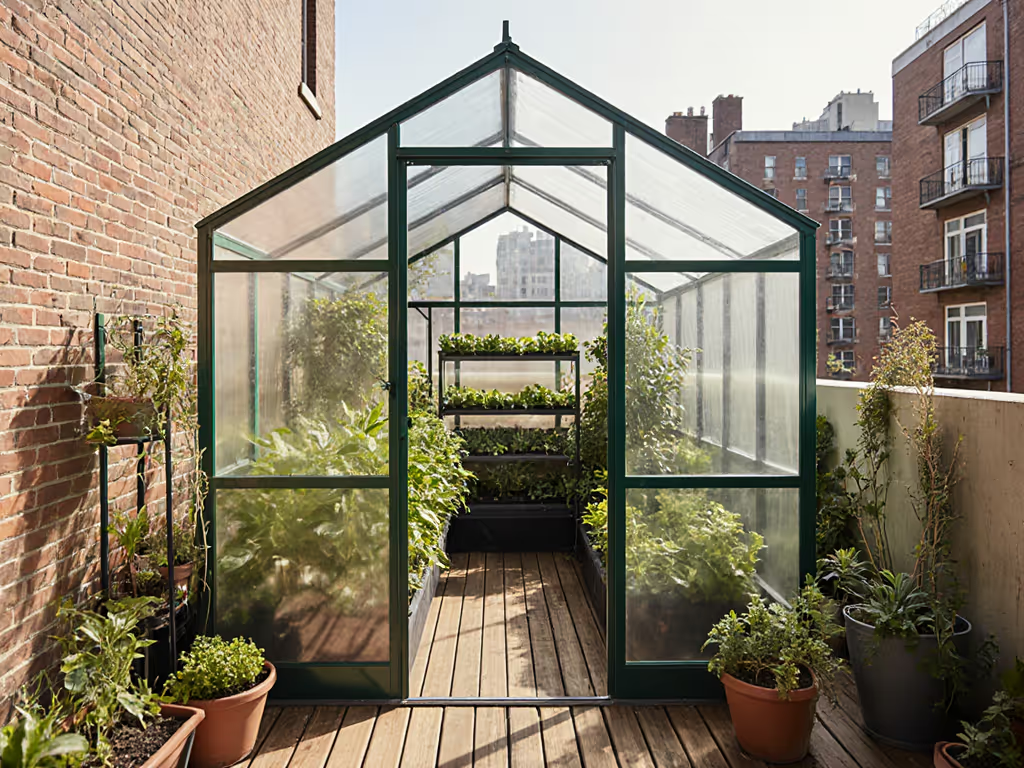
You've narrowed your search to a Palram Canopia greenhouse (likely the Hybrid 6×4, the 8×12, or the larger Glory models). The appeal is obvious: polycarbonate glazing, a relatively affordable entry point, and dozens of customer photos showing them thriving in suburban yards. But before you order, you need to hear something uncomfortable: Palram's durability claims don't hold up uniformly in the field. Some owners report survival through 80+ mph hurricane winds. Others watched 20 mph gusts tear panels loose and topple the frame entirely. That gap between testimonials isn't coincidence, it's the signature of incomplete assembly guidance, unclear anchoring protocols, and a misleading marketing narrative around wind resistance.
The real question isn't whether the Canopia by Palram can work for you. It can. The question is whether you'll invest two days of assembly, $1,500-3,500, and months of gardening only to watch it fail when the weather turns. That's a risk worth interrogating now. For model-specific, long-term testing, read our Palram Canopia durability review.
The Assembly Reality: What the Manual Won't Tell You
What the Kit Includes, and What It Asks You to Assume
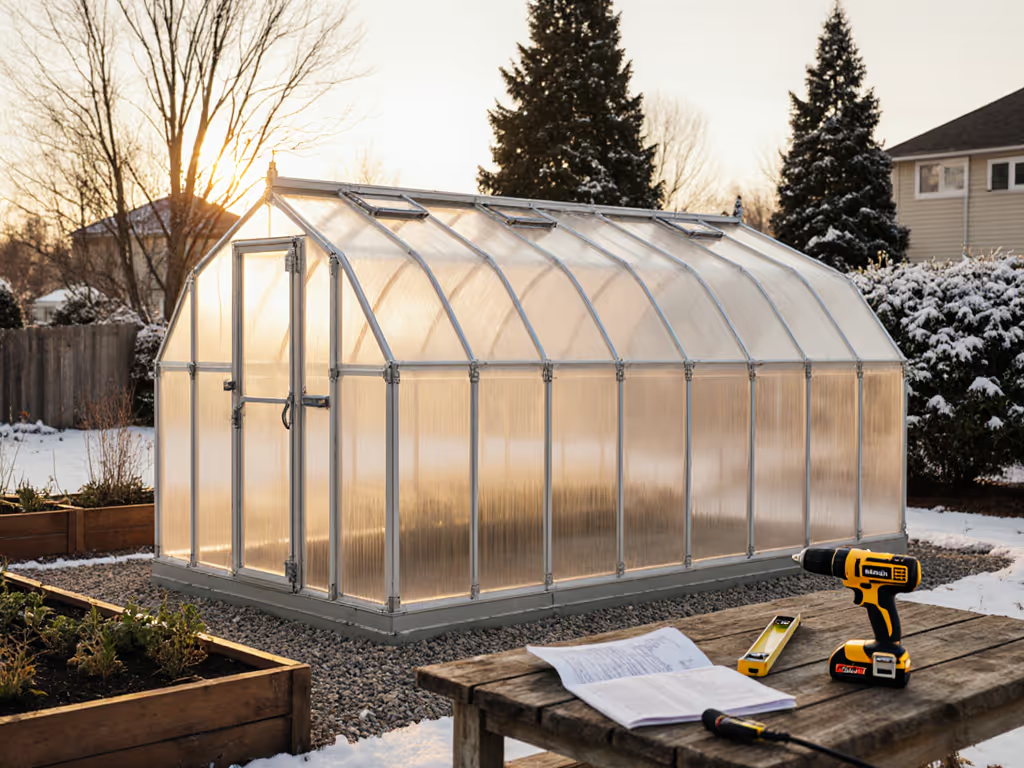
The Palram 8x12 greenhouse (or any Canopia model in this range) arrives as a flat-pack with pre-drilled aluminum frame members, polycarbonate panels, hardware, and an instruction booklet. On the surface, assembly is straightforward: bolt together the frame perimeter, slide panels into the glazing channels, attach the roof, add the door, and anchor to the ground.
Reality is messier.
First, the hardware. Bolts are typically M8 or M10 with hex nuts and washers. The manual specifies torque values (usually 12-18 Nm (9-13 ft-lbs)) but does not account for the brittleness of polycarbonate panels or the precision required to avoid over-torqueing and cracking them. The assembly instructions assume you own a torque wrench. Most DIYers don't. They hand-tighten and guess. That guessing costs you safety margin.
Second, the vertical alignment. During assembly, the frame will sag slightly as you bolt panels into place. If you don't account for that deflection, your door frame will bind, your panels will stress-crack under wind, and your roof ridge won't be level. The manual shows a simplified diagram; it doesn't explain how to use a 4-foot level or a transit to verify plumb and square at each stage.
Third, the foundation. Canopia's instructions typically show anchoring bolts screwed into the ground with a hardware kit. No mention of frost depth, soil bearing capacity, or the risk of uplift failure. More on this below. Get footing specs by soil type in our soil-specific greenhouse foundation guide.
Assembly Time Estimates: Plan for a full day minimum, closer to 10-12 hours with a second person for panel handling. If you anchor properly (see below), add another 3-4 hours. Don't rush this. Rushing invites misalignment, stripped threads, and a structure that wobbles from day one.
Site Prep and Foundation: Where Most Kits Fail
A lean greenhouse kit is only as strong as its anchor points. This is where I see failure modes cluster.
The Canopia anchoring kit typically includes concrete anchors or U-bolts meant to screw into the ground. In sandy or clay soil, these work adequately until wind load exceeds the soil's shear resistance. In freeze-thaw zones, frost heave can lift the entire frame. In sandy soil, anchors pull loose as soil compacts and shifts.
Here's the checklist I recommend instead:
- Locate and mark frost depth for your zone (contact your local extension office). Anchors must extend 12-18" below frost line.
- Test soil bearing capacity by digging two 12-inch holes at opposite corners of your greenhouse footprint. Note the soil color and texture. Sandy soil needs deeper anchors. Clay with gravel is good.
- Pour concrete piers (not just screwed anchors) at all four corners, and ideally at mid-span if the greenhouse is longer than 10 feet. Use deck footings rated for 2,500+ lbs per pier. This adds $200-400 but eliminates the most common failure mode.
- Use galvanized lag bolts (3/8-inch diameter minimum) torqued to 80-100 ft-lbs. Don't reuse fasteners; buy new hardware each time you anchor.
- Verify wind exposure. Is the site in a corridor between buildings or trees? Is it on a ridge? Wind speed can increase 30-50% in funneled terrain. Adjust anchor spec if necessary.
Real-World Durability: What the Data Say
Wind Performance - Where Claims Diverge
Canopia markets the Hybrid and Glory models as capable of withstanding winds up to 55 mph. A detailed field review from a Hurricane Helene experience confirmed that the greenhouse survived gusts exceeding 80 mph (though a lattice panel fell into it and the polycarbonate held, suggesting the glazing itself is robust).
But here's the critical caveat: that survival depended on proper anchoring and site conditions. In a separate report, an identical model was destroyed by 20 mph winds in Zone 9b. The difference? The second owner had used only the factory anchors without concrete piers, had not torqued fasteners consistently, and had not braced the roof ridge against lateral load.
Wind tolerance for a Canopia greenhouse depends almost entirely on assembly quality and foundation depth, not the factory specs.
Think of it this way: the frame's theoretical wind-resistance rating assumes perfect bolting, adequate anchoring, and no pre-existing stress in the polycarbonate. In practice, assembly mistakes, undersized anchors, and poor site prep erode that rating by 30-50%.
For a realistic safety margin, assume 35-40 mph as the practical wind limit unless you have upgraded anchoring (concrete piers, deeper bolts) and professional verification. Strong enough is not enough. You need measurable certainty.
Snow Load and Roof Pitch
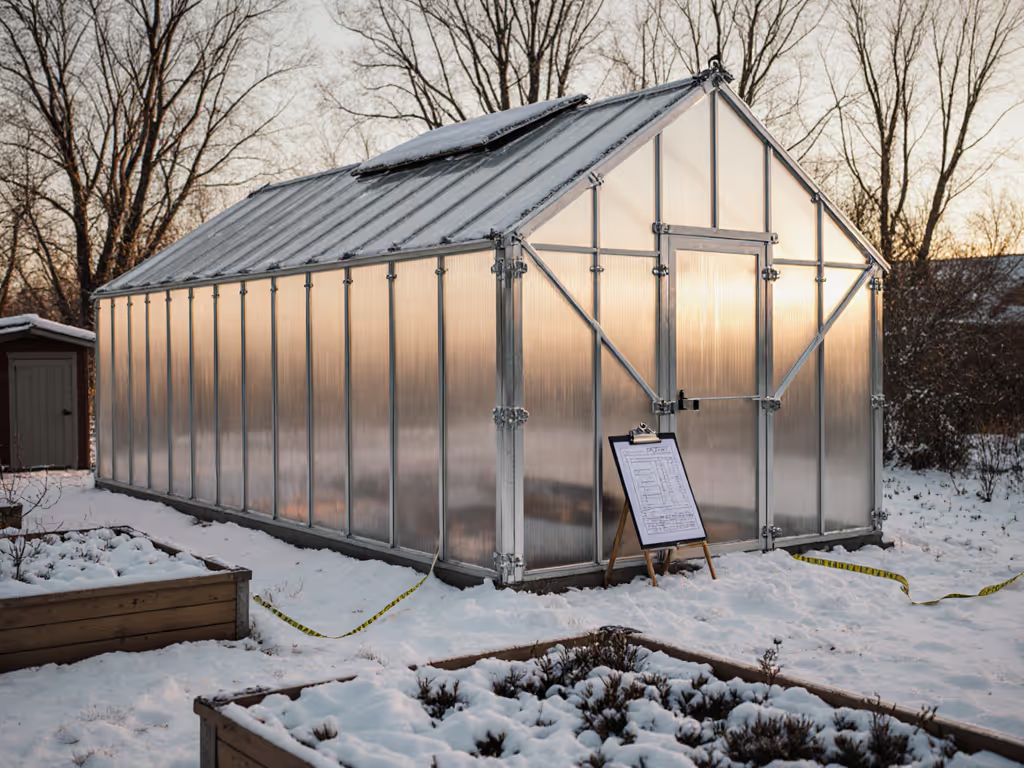
The Canopia roof pitch is typically shallow, around 15-20 degrees, which looks elegant but traps snow. In snow-prone regions (Northeast, upper Midwest, Rocky Mountain areas), a shallow roof becomes a liability. Snow loads of 40-60 lbs/sq. ft. are common in those zones; a 6×12 greenhouse roof has roughly 75 sq. ft. of surface area, meaning 3,000-4,500 lbs of potential weight on an aluminum frame rated for perhaps 1,500 lbs distributed load. If heavy snow is routine, compare cold-climate snow load ratings across kits.
The standard guidance: if you live north of the 40th parallel or in a zone with more than 20" of annual snowfall, roof pitch matters. I'd recommend increasing pitch to 30 degrees if you can, or invest in a movable snow rake and a winter maintenance schedule. Neither is ideal; either adds cost or labor.
Polycarbonate Durability: UV Degradation and Thermal Shock
The polycarbonate panels are genuinely durable, I'll grant that. They're impact-resistant (which the Hurricane Helene test confirmed) and won't shatter like glass. However, UV degradation is real. See how polycarbonate stacks up to other coverings in our polycarbonate covering guide. After 5-7 years in intense sunlight, polycarbonate begins to yellow and transmit less light. This is not a manufacturing defect; it's inherent to the material in unshaded, high-UV climates (Southwest, high altitude, equator-facing sides without shade cloth).
Expect panel replacement costs of $600-1,200 per side by year 8-10, depending on local UV index and your climate.
Thermal shock (rapid temperature swings between hot interior and cold exterior) can also cause micro-fractures in panels. If condensation freezes on the interior and then experiences 100°F+ swings between day and night, panel stress increases. This is most acute in spring and fall in variable climates. Proper ventilation mitigates this, but it's not failsafe.
Assembly Quality: The Torque Spec That Changes Everything
A Practical Checklist for Proper Bolting
Most greenhouse kits ship with M8 or M10 bolts. Here's how to tighten them properly and know you're within safe margin:
- Hand-tighten all bolts first, using only finger strength. This ensures alignment and prevents cross-threading.
- Invest in a torque wrench (beam or click type, $30-80). Borrow if necessary.
- Torque to 15 Nm (11 ft-lbs) for M8 bolts and 22 Nm (16 ft-lbs) for M10 bolts, in a three-step sequence:
- First pass: 50% of target torque
- Second pass: 75% of target torque
- Final pass: 100% of target torque
- Leave a nut wrench on every bolt and check them monthly for the first year. Vibration, wind, and thermal movement cause relaxation. If you find a loose bolt, re-torque to spec and document the date.
- Do not use power tools (impact drivers) for final tightening. The sudden torque spike can strip threads or shatter polycarbonate if the bolt head is near a panel edge.
I've walked dozens of failed greenhouses. The majority had hand-tightened bolts that had relaxed by 20-30% within three months. The owners couldn't see the problem; they just felt the frame shift in the wind and watched panels crack. Re-torquing every fastener with a calibrated wrench costs a few hours but eliminates most of that risk.
Sizing: Why "Bigger Than You Think" Isn't Just Comfort, It's Durability
The 6×4 Trap
Canopia's entry-level model (the Hybrid 6×4) is popular because it fits suburban backyards and carries a price tag around $1,200-1,500. But here's the hard truth: a 6×4 greenhouse (24 sq. ft. of floor space) fills up fast. One 3-tier bench takes up half the footprint. Add irrigation, a shelving unit for propagation, and a few standing plants, and you're at capacity.
When a greenhouse is crowded, two things happen:
- Airflow is compromised. Dense planting traps humidity, fostering mold, powdery mildew, and fungal diseases. You end up over-venting or overheating to compensate.
- Maintenance becomes a chore. You can't move around to pinch back plants, rotate pots, or identify early pest infestations. You skip checks and problems compound.
A crowded greenhouse underperforms and fails faster.
The Palram 8x12 greenhouse (96 sq. ft.) is a meaningful step up. You can walk down a center aisle, place benches on both sides, and still have room to move. Airflow is easier to manage. The larger roof mass also reduces stress concentrations on fasteners.
If budget allows, the 8×12 or a similar 8×10 model is worth the extra $500-800. You'll use it longer, maintain it better, and suffer fewer failure modes simply because the geometry is less aggressive.
Temperature Management: The Overheating Reality
Ventilation and Glazing Matter
Canopia greenhouses typically include roof vents (operable windows) but not automatic vent openers. On a 70°F spring day, interior temperature can reach 95-100°F within three hours if vents are closed. On a 90°F day, interior can spike to 115°F or higher, killing tender seedlings and stressing mature plants.
Here's what real owners report:
- Manual venting is labor-intensive. Open in the morning, close at night, adjust on cloudy days, it's a daily chore if you work a day job.
- Overheating causes more crop loss than cold. A cold frame or insulation mitigates frost risk; overheating is harder to manage retroactively.
- Hybrid polycarbonate (half diffused, half clear) helps but isn't a cure. Diffused panels reduce direct solar gain by ~20%, but in intense climates, that's not enough.
If you live in the Southwest, high-altitude, or any zone with more than 30 days/year above 85°F, budget for either:
- Automatic vent openers ($150-250 per vent, open/close based on interior temp)
- Shade cloth (40-50% opacity, deployed April-September, $200-400)
- Evaporative cooling (pad-and-fan or misting system, $400-800)
One of these three is not optional in hot climates, it's foundational to four-season success. Start with our ventilation kit comparison to prevent summer crop loss.
The Honest Durability Score: What You're Actually Buying
If I were to assign a durability rating to the Palram Canopia line, here's my breakdown for a typical homeowner in a temperate climate (USDA Zones 5-8) with proper anchoring and assembly:
Frame durability: 3.5 / 5
- Aluminum is lightweight and corrosion-resistant, but fastener relaxation and micro-movement are common.
- Requires annual inspection and re-torquing.
- Replace fasteners every 5-7 years.
Glazing durability: 4 / 5
- Polycarbonate is genuinely tough and impact-resistant.
- UV degradation after 5-7 years; plan for panel replacement by year 10.
- Condensation can form but dissipates with proper ventilation.
Wind resistance (with proper anchoring): 3 / 5
- Practical limit: 35-40 mph sustained without reinforcement.
- Exceeds that with upgraded anchors (concrete piers) and bracing.
- Without proper anchoring: 1 / 5. It will fail in moderate wind.
Snow load tolerance: 2.5 / 5 (in snow zones)
- Shallow pitch is a liability in heavy snow regions.
- Manual snow removal is required above 20" annual snowfall.
- Roof bowing and panel stress occur under heavy wet snow.
Overall expected lifespan: 8-12 years with routine maintenance and annual torque-verification.
- Longer with upgrades (additional bracing, shade cloth, ventilation automation).
- Shorter in extreme wind, snow, or high-UV zones without mitigation.
That's not a weakness, it's a realistic expectation. A $1,500 kit performing for 10 years at $150/year is reasonable value. But you need to own the maintenance burden.
The Path Forward: Assembly and Activation Checklist
If you've decided a Palram Canopia greenhouse fits your goals and climate, here's how to de-risk the build:
Pre-Assembly (1 week before delivery)
- Confirm site location. Orient the greenhouse lengthwise north-south if possible to reduce east/west solar load in summer.
- Mark frost depth for your zip code. Dig test holes to verify soil type.
- Order concrete deck piers (4-6, depending on greenhouse length) and galvanized lag bolts (3/8", 4-6 bolts).
- Obtain or borrow a torque wrench rated for 0-30 Nm. Check its calibration.
- Verify local building codes and HOA rules. Many jurisdictions require setback distances (5-10 feet from property line) or permits for structures over a certain size.
Assembly Day (Plan for 10-12 hours with two people)
- Lay out all parts in the order you'll install them. Verify nothing is missing or damaged.
- Assemble the frame perimeter on a level surface (not on the ground). Use shims to ensure square and level.
- Transfer the frame to the site and place on the concrete piers. Use a level to verify it's plumb and square. This is tedious but critical.
- Install panels as you go, hand-tightening bolts only. Don't torque until all panels are in place and the frame is verified square.
- Torque all fasteners using the three-step method above.
- Install roof panels and door frame. Verify the door swings freely without binding.
- Install vents and hardware. Test operation under light load (not full force).
Post-Assembly (Weeks 1-4)
- Wait 48 hours, then re-torque every fastener to 50% of spec and verify alignment.
- Week 2: Re-torque to 75% of spec. Check for any frame movement.
- Week 4: Final torque to 100% of spec. Document in a maintenance log.
- Install shade cloth or vent openers if your climate requires it.
- Perform a wind test: Gently push on the frame at the roof peak. If it flexes noticeably (>1 inch sideways), anchors are too shallow, upgrade immediately.
Annual Maintenance
- Spring: Check all bolts with a torque wrench. Re-torque any that are loose.
- Summer: Clean panels and inspect for cracks or UV damage.
- Fall: Clear gutters and roof vents. Remove heavy debris.
- Winter (in snow zones): Monitor roof load. Deploy a snow rake if snow depth exceeds half the roof length.
The Bottom Line: Overbuild Once; Sleep Through the Wind Warnings at Night
A Palram Canopia greenhouse is a capable, affordable entry point into season extension. But its durability, and yours, depends on three factors you control: proper site preparation (concrete piers, not token anchors), meticulous assembly (torque spec, not guesswork), and climate-matched upgrades (shade cloth, ventilation, snow management).
Many buyers skip these steps to save cost or time. They pay for it later when wind, hail, or snow arrives. The greenhouse fails, the crop dies, and the investment evaporates.
Instead, invest an extra weekend and $500-800 upfront in proper anchoring, fastener verification, and climate-specific upgrades. You'll gain 3-5 extra years of reliable performance and eliminate the most common failure modes entirely. That's not overkill; it's insurance you'll actually sleep through.
The market is full of greenhouses. The question is which one will still be standing, producing, and looking fresh in year 10. If you follow this checklist, your Canopia will be one of them.
Your next step: Use the assembly and maintenance checklist above before you order. Share it with a building inspector or local extension agent to confirm soil bearing capacity and anchoring depth for your specific zip code. Then order with confidence, knowing you've eliminated the most common failure modes.
Related Articles